
Risk Preparedness and Response
Bhimsar, Rajasthan
Operating in a fast-evolving renewable energy sector, we have integrated risk management across all levels of strategy and operations to proactively address uncertainties. Over the year, we have reinforced our enterprise risk management (ERM) framework with structured governance oversight and alignment with global frameworks. This enables early risk identification and conversion of challenges into strategic opportunities, strengthening our ability to navigate uncertainties with resilience.
Enterprise Risk Management (ERM) Approach
We have a robust ERM framework aligned with ISO 31000:2018 and COSO 2020. Our framework considers ESG, qualitative, quantitative, internal and external factors to enable early identification of risks, effectively mitigate their adverse impact and convert challenges into strategic opportunities. It ensures systematic management of strategic, operational, financial, ESG-related, and reputational risks to protect business continuity and support sustainable growth. The framework is guided by a Risk Management Policy that ensures effective corporate governance and supports identifying, analysing, assessing, mitigating and monitoring existing and potential risks. We update the framework annually to reflect evolving external conditions and stakeholder expectations. This structured, adaptive approach fosters a culture of risk awareness and strengthens resilience to navigate uncertainty.
Purpose and Scope
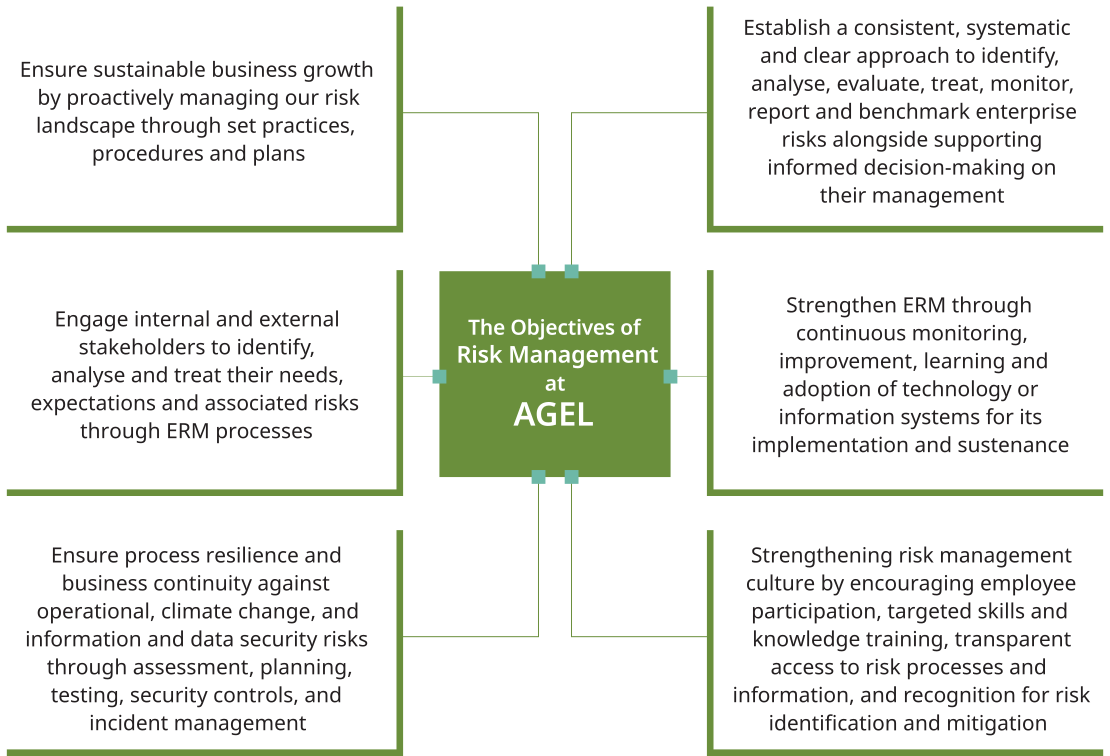
The ERM Framework aims to establish, deploy, and continually strengthen risk management practices. It applies to all key functions, including projects, O&M plants, and internal and external events that may impact business objectives.
Risk Governance
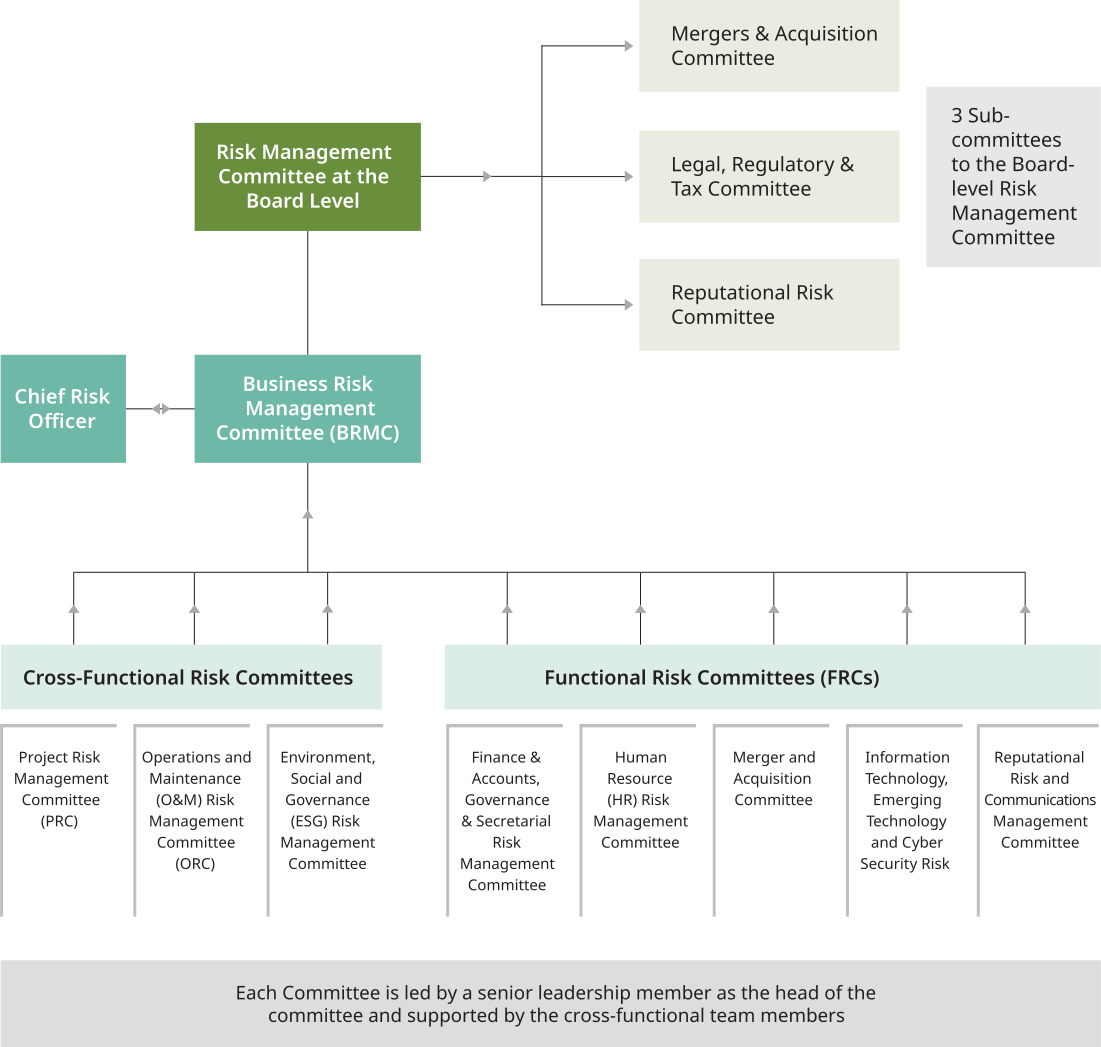
Our ERM process is strengthened by a three-tier risk governance, comprising senior leadership and functional teams with clearly-defined roles and accountability. This cross-functional coordination, along with regular assessment, ensures the framework’s responsiveness to evolving operational and market dynamics. The Board-level Risk Management Committee (RMC) provides strategic oversight, reviews risk strategies, and ensures alignment with our risk appetite. The Chief Risk Officer (CRO), supported by various functional risk committees, governs the framework. The Independent MAAS team provides independent assurance and reports directly to the Board-level RMC, ensuring transparency, objectivity, and alignment with enterprise goals.
Roles and Responsibilities of the Risk Management Team
Risk Management Committees at the Board-level
- Provide strategic oversight and guidance, review risk strategies and ensure alignment with risk appetite
Business Risk Management Committee (BRMC)
- Ensure effective execution of Board-level risk policies under the CEO’s leadership
- Monitors compliance, evaluates mitigation strategies, and guides functional risk teams across business units
Chief Risk Officer (CRO)
- Lead ERM including designing, executing and refining risk management strategy
- Prioritise business risks, review risk registers quarterly, and ensure alignment with evolving business objectives and external conditions
- Conduct regular BRMC meetings
Risk Owner (functional heads) & Risk Champions
- Accountable for risk identification and mitigation execution
Functional/Cross-Functional Risk Committees
- Serves as the frontline for risk identification, leveraging domain expertise to detect emerging threats
- A dedicated Reputational Risk and Communications Committee addresses brand and communication-related risks
- All committees maintain detailed risk registers, reviewed quarterly by the CRO and BRMC for continuous oversight and timely response
Our Risk Governance Structure
Risk Management Process
We follow a structured six-step approach to identify and mitigate risks. This protects value creation against uncertainties, while positioning us to capture associated opportunities.
Risk Identification
- Identifying potential risks through expert judgement, brainstorming, root cause analysis/assumptions, constraints/SWOT analysis, and other techniques
- Recording potential risks that may impede achieving operational objectives and targets in the risk registers
Risk Analysis
- Assessing risk exposure level based on source, likelihood of occurrence, magnitude of potential impact, and mitigation strategies
- Assigning risk severity and likelihood scores aligned to COSO ERM
Risk Assessment and Prioritisation
- Identified risks are assessed using a structured impact and likelihood-based scoring methodology. Impact and likelihood scores are combined to derive an overall risk rating, which is mapped on a risk assessment matrix to prioritise risks as high, medium or low
- Prioritising risks based on the risk rating and classifying them into strategic, tactical, operational, or reputational categories
- Impact and likelihood scores are mapped on a 5×5 risk assessment matrix to prioritise risks into High, Medium and Low categories; risks are evaluated on both an inherent and residual basis, with residual risk reflecting post-mitigation exposure, enabling focused decision-making and efficient allocation of resources to critical risk areas
- Assigning risk ownership, with a timeline to prioritise and assess risks
Risk Mitigation
- Developing and implementing risk mitigation strategies by the risk owner and champions at each business level, with cost-benefit analysis, indicators, and target timelines
- Monitoring responses and intervening as required
Risk Treatment
- 4T approach to treat risks:
- Transfer the risk through third-party insurance
- Terminate the risk by making process changes
- Tolerate risks that may have a low impact on operations
- Treat through corrective action plans to reach a tolerable level
Review & Monitoring
- Periodic review and monitoring of risks by the BRMC, Board-level Risk Committee and Functional Risk Committee to ensure compliance with defined mitigation strategies
- Tracking progress of mitigation actions
- Gathering insights from the ongoing process for further analysis and developing an organisation-wide learning process
- Risk management practices are periodically benchmarked against industry peers, and key mitigation controls are independently tested and validated to assess their design and operational effectiveness, with outcomes reviewed by the Business Risk Management Committee (BRMC) to drive continuous improvement
Risk Categorisation
We undertake to categorise all risks into eight buckets to ensure clarity, prioritisation and accountability. This helps in developing customised controls as per the risk type and thus improving decision-making and resilience. The risk categories are as follows:
Business & Commercial Risks
Risks arising from business strategy, expansion, infrastructure needs, market volatility, and policy changes.
Environmental & Social Risks
Environmental risks stem from changing weather patterns that may impact business continuity. Social risks arise from community conflict, stakeholder relationships, employee health and well-being, supply chain management, breach of code of conduct by employees, and human rights violations of contractual workforce.
People Risks
Risks arising from the well-being and development of employees, including human rights, that may impact organisational talent, productivity and attrition.
Operations & Maintenance (O&M) Risks
Risks related to asset O&M, asset life cycle management, and events that can lead to interruption, forced shutdown and even closure of plants.
Financial Risks
Risks arising from reduced access to funds, cost overruns, inability to generate desired returns, and external factors like stock market volatility, increased interest rates, adverse economic scenarios, and transaction failures.
Project Risks
Risks arising from project development, engineering, procurement, construction, and management, including incidents of health, safety, and disasters.
Regulatory & Governance Risks
Risks arising from changing regulations that can negatively impact business.
Information Technology (IT) & Cybersecurity Risks
Risks arising from the availability, connectivity, integrity, and reliability of IT infrastructure and exposure to cyber breaches such as data thefts, hacking, and scams.
Enterprise Risk and Mitigation Strategies
Risk Description
Risks of increased competition in renewable energy auctions, pressure on bid tariffs and merchant market pricing.
Capitals at Risk

Strategy at Risk
Material Topics
Impact on Value
- Decline in the electricity tariffs and margins
- Reduced competitiveness in new capacity additions
Mitigating Measure
- Disciplined project selection and bidding aligned to risk-adjusted returns
- Strategic partnerships and scale- and technology-driven cost efficiency to enhance competitiveness
- Robust techno-commercial capabilities with integrated cross-functional support for competitive bids
- Ongoing optimisation of capital structure, execution capabilities and business strategy to the evolving market
- Explore international markets, energy storage, C&I and mid-duration hybrid opportunities
Associated Opportunities
Cost leadership, execution excellence and a track record of reliable power supply give our portfolio a ‘must-run’ status with priority despatch.
Risk Description
Risk associated with volatility in electricity demand-supply dynamics and prices on the energy exchange.
Capitals at Risk

Strategy at Risk
Material Topics
Impact on Value
- Loss of revenue and cash flow unpredictability
- Asset underutilisation
Mitigating Measure
- Maintaining a prudent balance between long-term PPAs and merchant exposure with close monitoring of merchant rates
- Short/long-term power sale arrangements through bilateral contracts or exchange to optimise realisation and mitigate pricing risk
- Merchant projects structured with higher equity contribution
Associated Opportunities
Our focus on building merchant capabilities through flexible despatch, storage integration and competitive tariffs supports carbon transition plans for industries, while opening potential for enhanced realisation.
Risk Description
Exposure to region-specific regulatory, climatic, or grid-related risks due to higher geographical concentration
Capitals at Risk

Strategy at Risk
Material Topics
Impact on Value
- Localised operational disruptions
- Disproportionate impact on revenue
Mitigating Measure
- Operational assets spread across 12 resource-rich states and renewable resource zones
- Portfolio spread across solar, wind, and hybrid assets reduces location-specific dependency
- Ongoing expansions in Rajasthan and Gujarat, India’s most solar and wind-resource-rich states
Associated Opportunities
Our multi-location presence positions us to address the growing power demand in the respective region.
Risk Description
Inability to service debt obligations could affect financial stability
Capitals at Risk

Strategy at Risk
Material Topics
Impact on Value
- Decline in credit rating
- Reputation loss
- Increased cost of borrowing
- Reduced access to capital
Mitigating Measure
- Ongoing refinancing and liability management initiatives
- Maintaining debt service reserve account (DSRA)/cash balances for 3-6 months of debt servicing to prevent delay or default
- Project financed with long-term debt exposure at low cost
- Improving credit profile, with 82% credit rated above ‘AA-’ as on March 31, 2026
Associated Opportunities
Our sustained focus on debt management opens potential to improve capital efficiency and debt maturity profile through refinancing and liability optimisation.
Risk Description
Insufficient liquidity or access to finance may affect the ability to meet financial obligations or growth capex
Capitals at Risk

Strategy at Risk
Material Topics
Impact on Value
- Decline in credit rating
- Reputation loss
- Delays in project execution
Mitigating Measure
- Robust liquidity management with regular reviews and rapidly growing run-rate EBITDA (43.7% 5-year CAGR)
- Strong liquidity with further equity infusion by promoters for fully funded growth
- Proactive capital management plan spread across time periods and funding sources, ensuring funding flexibility
Associated Opportunities
We are continually exploring diversified funding instruments and capital markets to enhance financial flexibility, alongside faster execution and robust O&M to enhance cash profit.
Risk Description
Exposure to fluctuations/volatility in the exchange rate or interest rates from foreign currency borrowings and imports
Capitals at Risk

Strategy at Risk
Material Topics
Impact on Value
- Increased finance or procurement costs and potential loss
- Increase in debt service obligations
Mitigating Measure
- Structured hedging strategy for interest rate and foreign currency exposures
- Long-term capital management plan supported by a sound international credit rating ensures optimised financing cost while meeting growth targets
- Active treasury monitoring and periodic risk assessment
Associated Opportunities
Effective management of foreign exchange and interest rate exposures optimises financing and procurement costs while improving cash flow predictability. A disciplined treasury approach supports stable margins, efficient capital allocation and access to diversified funding sources for long-term growth.
Risk Description
Delays in project execution due to land acquisition challenges, supply constraints or evacuation-readiness
Capitals at Risk

Strategy at Risk
Material Topics
Impact on Value
- Delayed commissioning and loss of revenue
- Cost overruns and contractual penalties
- Lower return on investment
Mitigating Measure
- Advance site due diligence, acquisition and ROW clearance with the help of local stakeholders aligned with the business plan
- Effective vendor/contractor management, including pre-qualification, performance evaluation and deboarding non-performers
- Robust project governance across resource assessment, technical studies, land acquisition and execution-readiness, supported by engaging reputed tier I or II agencies and an established local supplier network
- Proactive approach and public relations with government bodies like PGCIL to ensure power evacuation and grid-readiness
- Deploying innovative execution measures, including deploying robotics and digitalisation and operating a centralised control room for real-time monitoring with AI/ML-enabled analytics
Associated Opportunities
Executing at speed and scale, including the development of the world’s largest 30 GW Khavda renewable energy park and hydro pumped and battery energy storage solutions, positions us to take a leadership role in India’s RE goals while ensuring grid stability.
Risk Description
Risks of volatility in commodity prices, unavailability of key materials (silicon wafers, solar cells and modules), or disruptions in local or international supply chains
Capitals at Risk

Strategy at Risk
Material Topics
Impact on Value
- Increased capital expenditure
- Delays in material delivery and project execution
Mitigating Measure
- Disciplined material cost management, ensuring no unhedged raw material positions during tariff bidding in auctions
- Fixed rate procurement contracts with price variation clauses where feasible
- Active monitoring of commodity and supply market trends to ensure strategic bulk buying at favourable prices
- Long-term strategic tie-up for logistics and free on board (FOB) based freight booking
- Backward integration of solar and wind manufacturing at the Adani Portfolio level and relations with strategic vendors enhance supply reliability and cost-efficient procurement
Associated Opportunities
Our efforts around building a strong localised supply chain and supporting their capability building positions us to deliver unprecedented speed and scale of execution with optimum procurement cost.
Risk Description
Loss of critical talent and high employee turnover may affect project execution and operational continuity
Capitals at Risk

Strategy at Risk
Material Topics
Impact on Value
- Productivity loss and intellectual capital
- Increased hiring and skilling costs
- Operational disruption
Mitigating Measure
- Identification and retention of high-potential and critical role talents, with a structured career development path and succession planning
- Competitive remuneration and reward & recognition mechanisms
- Continuous learning & development, engagement, well-being and leadership engagement initiatives
Associated Opportunities
Building a future-ready pipeline of workforce with deep technical and digital capabilities enables us to stay ahead of renewable energy technology evolution and tap emerging opportunities.
Risk Description
Cyber threats and system breaches may disrupt critical IT services and operational systems and impact data integrity
Capitals at Risk

Strategy at Risk
Material Topics
Impact on Value
- Exposure, destruction or corruption of sensitive data
- Failure of IT services
- Network breakdown
- Reputational impact and legal penalties
Mitigating Measure
- Invested in robust IT security infrastructure, with firewall and endpoint protection
- Defined policy and procedure for data privacy, employee privacy, and data retention, disposal and breach management, along with continuous compliance monitoring
- Regular patch management to mitigate vulnerability related to OEM products
- Regular employee awareness sessions on phishing and cybersecurity aspects
Associated Opportunities
Investments in advanced technologies and digital resilience support acceleration in renewable energy adoption and make energy production more sustainable.
Risk Description
Operational vulnerabilities in SCADA systems may impact real-time monitoring and plant control
Capitals at Risk

Strategy at Risk
Material Topics
Impact on Value
- Lower plant efficiency, energy despatch, and revenue
- Increased costs due to delayed fault detection and response
Mitigating Measure
- Centralised, analytics-driven O&M system (ENOC) facilitates real-time monitoring, insights and responsiveness
- Secure, remote access to SCADA for third parties through virtual desktop infrastructure
- Use of resilient multiprotocol label switching (MPLS) architecture to improve network resilience and security
- Periodic maintenance of SCADA
Associated Opportunities
Stronger SCADA systems improve predictive maintenance, faster fault response and plant availability.
Risk Description
Variability in solar irradiation and wind availability, versus projections, may lead to insufficient power generation and an inability to meet contractual obligations
Capitals at Risk

Strategy at Risk
Material Topics
Impact on Value
- Loss of revenue
- Penalties or loss of incentive payments
Mitigating Measure
- Site selection and analysis of CUF and generation budgeting based on long-term weather analysis and forecasting through in-house AI/ML-based tools and continuous model training
- Major sites located in Rajasthan and Gujarat, which have India’s highest solar irradiation/wind speed
- Portfolio diversification across geographies and technologies, along with active tracking and mitigation of CUF-related deviations
Associated Opportunities
Effective site selection enhances generation stability and enables us to stay invested in India’s energy security amid energy price volatility and geopolitical uncertainty.
Risk Description
Renewable technology advancements may render existing equipment obsolete and less competitive over time
Capitals at Risk

Strategy at Risk
Material Topics
Impact on Value
- Plant outages and unavailability
- Reduced asset efficiency
- Replacement cost and delay in delivery of spare components for obsolete technology
Mitigating Measure
- Deployment of proven, bankable technologies
- Long-term service agreements with OEM for critical technology, with a clause to access design and technical documentation in the event of technology obsolescence or business discontinuation
- Long-term contracts and buyback arrangements wherever possible
Associated Opportunities
Adoption of bankable, future-ready technologies upgrades asset performance and ensures long-term competitiveness.
Risk Description
Risk of non-compliance with statutory requirements, environment management plans or statutory obligations
Capitals at Risk

Strategy at Risk
Material Topics
Impact on Value
- Litigations/qualification in statutory reports
- Penalty and regulatory sanctions
- Reputation damage
- Loss of licence or approval
Mitigating Measure
- Robust compliance framework with defined accountability (department heads) and periodic Board-level oversight and third-party assessments
- Technology-led tracking, monitoring and managing of economic, environmental and social compliance through the Legatrix system
- Robust internal controls and audit mechanisms, with structured reporting and escalation matrix for non-compliance
Associated Opportunities
Best-in-class compliance frameworks strengthen governance credibility and position as a key player in democratising access to renewable energy by developing ambitious capacity.
Risk Description
Changes in regulatory framework, tariff structures or approval process may affect long-term prospects and expansion plans
Capitals at Risk

Strategy at Risk
Material Topics
Impact on Value
- Financial unviability of existing and new projects
- Potential censure and operational slowdown
- Increased compliance and operating costs
Mitigating Measure
- Active engagement with industry associations and policy makers to ensure a conducive industry scenario
- Continuous tracking and assessment of regulatory developments supported by expert consultations
- Legal remedies from court/appellate tribunal as and when required
Associated Opportunities
Regulatory evolution across grid modernisation and greening, low-cost domestic manufacturing and electrification unlocks new growth avenues for renewable, hybrid, and storage-led solutions.
Sustainability Risks and Opportunities Management
The management of environmental, social and governance (ESG) risks is integral to our enterprise risk management. Our business is faced with ESG risks, including climate, biodiversity, water scarcity, safety and security of employee and reputational resilience. We proactively manage them through structured oversight, monitoring mechanism and the use of technologies.
Detailed articulation of mitigating actions can be read in our ESG report.
Capitals at Risk

Strategy at Risk
Material Topics
| Risk | Impact on Value | Mitigating Measure |
|---|---|---|
| Acute Physical RiskRisks of damage to infrastructure from extreme temperatures and weather events | Asset damage and operational downtime | Evaluated all sites and assets based on event type, intensity, and frequency |
| Chronical RiskLong-term risks beyond the immediate disruptions of natural disasters | Generational losses | Conducted scenario analyses to assess natural hazard impacts under current and future climate conditions across operations |
| Policy and Legal RiskRisks due to non-compliance with regulatory shifts can disrupt operations | Penalties and reputational damage | Using Legatrix to track evolving regulations across all locations |
| Technological RiskVulnerabilities to technical failures in the adoption of new technologies | Decline in asset competitiveness, capital losses, and long-term returns | Adopted 1500V DC technology with optimised string design to optimise land use, cable losses and capex efficiency |
| Market RiskRisks from volatility in global solar module supply and raw material availability | Manufacturing instability and business continuity | Disciplined material pricing strategies and a robust supplier network ensure competitiveness in tariff auctions |
Associated Opportunities
Climate-resilient infrastructure enhances asset reliability and reinforces leadership in India’s energy transition.

Badi Sid, Rajasthan