
Engineering Reliability into the Transition
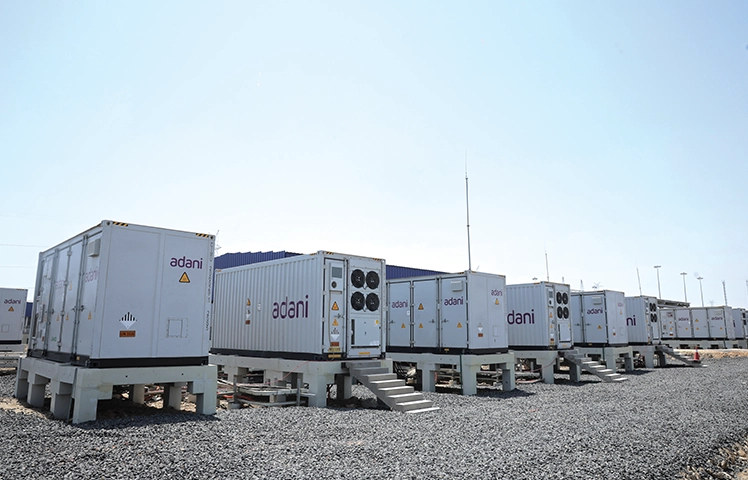
World’s largest single-location Battery Energy Storage System outside China
We are advancing energy storage as a strategic growth pillar, addressing intermittency and strengthening grid integration. Through long-term investment plans in hydro pumped storage projects (PSPs) and battery energy storage systems (BESS), we aim to build a resilient renewable ecosystem aligned with our commitment to strengthening India’s energy independence and low-carbon transition.
Advancing Hydro PSP Execution
We have five hydro-pumped storage projects, aggregating 5+ GW, across Andhra Pradesh, Uttar Pradesh, Maharashtra, Telangana, Tamil Nadu and Assam. These projects are progressing as planned, with the first 500 MW PSP on the Chitravathi River in Andhra Pradesh expected to be completed in one of the shortest timelines.
Building a Grid-scale BESS Platform
Strategic Entry with One of the World’s Largest Projects
We forayed into the BESS sector in FY 2025-26 with a pioneering project at Khavda. The system will have 1,126 MW power capacity and 3,530 MWh energy capacity to enable up to three hours of despatchable power at full capacity. As at March 2026, 1,376 MWh energy capacity has already been operationalised. The BESS uses advanced lithium-ion battery technology and energy management systems that support peak load management and energy shifting for optimal performance and reliability. The project will play a critical role in global clean energy evolution, enabling grid stability and renewable integration with round-the-clock power availability.
The 1,126 MW/3,530 MWh BESS deployment at Khavda with 700 containers is the largest such installation in India and among the largest single-location globally. This milestone project reinforces Khavda’s position as the world’s largest RE and storage park.
Scaling BESS Ambitions
BESS technology has strong potential to ease peak load pressures, reduce transmission congestion, and mitigate solar curtailment, thereby improving grid reliability and efficiency. Building on the flagship BESS deployment at Khavda, the Adani Portfolio of Companies has outlined a roadmap to scale its energy storage footprint to enable RE RTC, ease transmission congestion, and strengthen India’s energy security. The plan involves deploying more than double the capacity added in the current year.
AGEL, with an extensive land bank, large-scale renewable, evacuation and other supporting infrastructure and manpower availability, has a structural advantage to make this vision possible.