
Where Vision Translates into Reality, Every Day
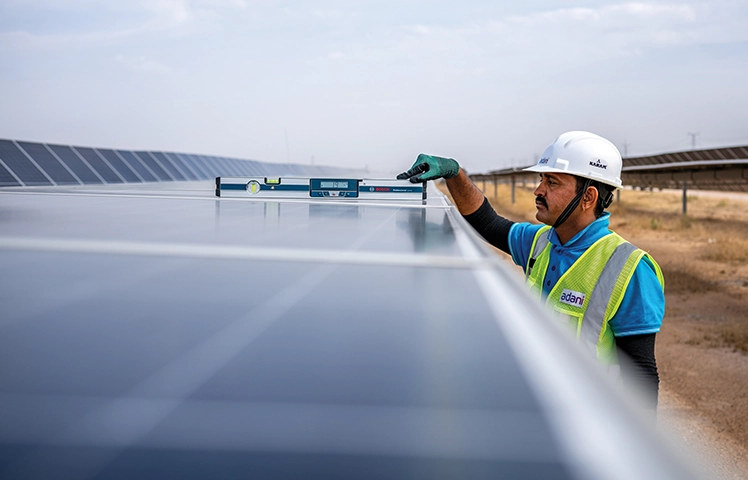
Badi Sid, Rajasthan
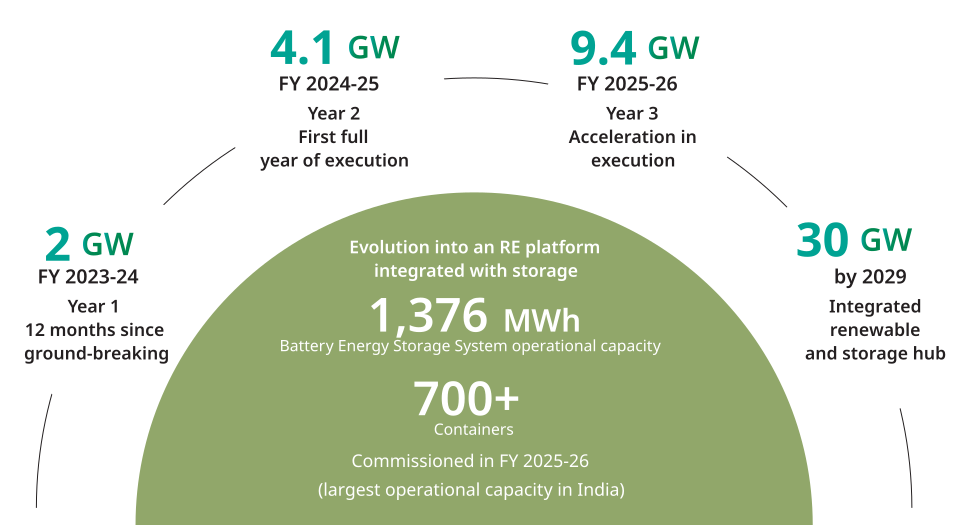
Just about two years ago, the 30 GW Khavda RE project was a vision which would be a global blueprint for gigawatt-scale execution. Today, it is no longer a vision. It is a global benchmark for speed, scale, technology and workforce deployment. It is where records are being broken and new milestones set. In 36 months since groundbreaking, 35% of the project is already complete, with momentum all set for completion by 2029.
Khavda Project Snapshot
Renewable energy capacity
Project area
clean energy generation potential
Homes targeted to be powered annually
Green jobs to be created
Targeted reduction (equivalent to carbon sequestrated by 3,027 million trees and 13.8 million cars off the roads)
Khavda: A Blueprint for Gigawatt-scale Execution
Strategic Location
- Strategically located in resource-rich region of Gujarat
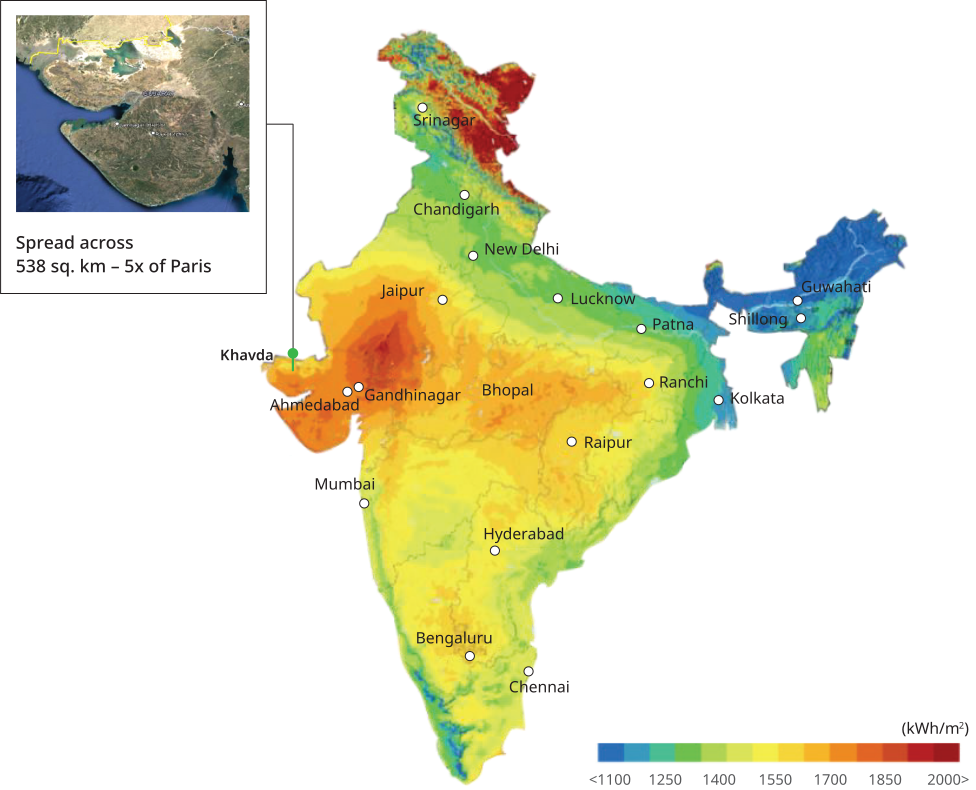
Arid, Non-cultivable Contiguous Land Perfectly Suited for Mega Scale RE Development
Solar irradiation of ~2,060 kWh/m²
Potential Solar CUF of 33%
Wind speed of ~8 metres/second
Potential Wind CUF of 35%+
Map not to scale. For illustrative purposes only.
- All projects to be developed on contiguous land in Khavda Renewable Park
- Significant scale efficiencies in construction and O&M
- Advance phase-wise evacuation planning matching project timelines
- Connection to the central grid and existing green corridor through high-capacity transmission lines, including 765 kV
- Topography survey
- Social geotechnical investigation and improvement test (for WTG foundation)
- Seismic, centrifuge and area drainage studies
- Customisation for cable laying, piling, extra high voltage (EHV) substation and more
- India’s largest centralised control room enabling real-time, AI/ML-driven monitoring
- Robotics and digitalisation for scale and speed
- Long-term collaborations with global ALMM-compliant solar module suppliers and supply chain integration within the Adani portfolio
- Well-developed site infrastructure to support project development and workforce well-being along with long-term work visibility, enabling large-scale and sustained workforce deployment
Accelerating Delivery at Scale
In FY 2025-26, the pace of execution at Khavda, the world’s largest renewable energy plant, reached new highs. Months of upfront planning, manpower mobilisation and infrastructure development, advanced technology deployment, and supply chain integration converged into a mature execution ecosystem, resulting in accelerated project delivery.
We commissioned 5.1 GW capacity during the year, making Khavda the largest contributor to our portfolio. As of March 31, 2026, the project’s operational capacity stood at 9.4 GW and it is firmly on track to achieve the full 30 GW by 2029, an execution timeline unmatched globally at this scale.
Khavda RE Park Execution Acceleration and Evolution
Technology at the Frontier
The Khavda project deploys advanced renewable technologies, making it one of the most efficient and environmentally friendly plants globally. They are poised to maximise generation, reduce water usage to near-zero, and enhance long-term asset performance.
Renewable Technologies Deployed at Khavda
- High-efficiency bifacial, n-type solar PV modules, with Horizontal Single-Axis trackers (HSAT)
- India’s largest and among the most powerful globally, 5.2 MW onshore wind turbines to optimise the levelised cost of electricity
- Waterless robotic module cleaning across the entire site
- Robotic installation of solar PV modules
People-centric Execution
Workforce management is a defining feature of the Khavda project’s success. With fully equipped labour colonies, healthcare facilities and comprehensive well-being infrastructure, it is designed for stability, safety, and productivity. Further, long-term work visibility ensures the continual availability of skilled labour.